
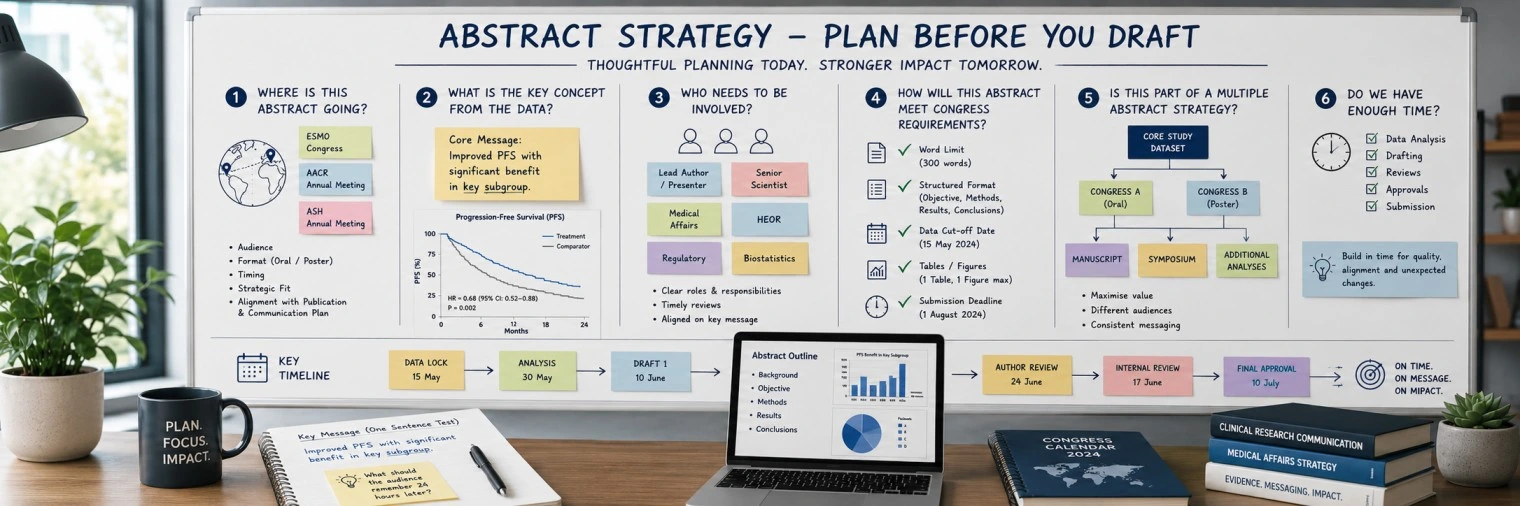
6 Questions to Ask Before You Draft an Abstract

Approx.
8 mins read

The success of an abstract is often shaped before the first draft is written. Decisions made during the early planning stages can influence not only the quality of the abstract itself, but also the impact of future presentations, publications, and wider communication activities.

Before drafting begins, it is important to consider a series of strategic and practical questions that help define the purpose, audience, message, and development process for the abstract. These questions act as a pre-drafting filter, helping teams improve clarity, align stakeholders, and maximise the overall impact of the research communication.

First Published: 
Jun 2026
Updated: 
First Published: 
Jun 2026
|
Updated: 

Other pages on the topic:

No items found.

Key learnings contained in this article:

Question 1: Where is this abstract going? 

Even before you begin drafting, it is important to decide where the abstract will be submitted. The target congress influences the audience, messaging, level of detail, and overall strategic value of the work. An abstract intended for a specialist scientific meeting may differ considerably from one designed for a broader clinical or payer audience.

Congress selection also affects the competitiveness of the submission and the type of data likely to be prioritised. Large international congresses often favour novel or practice-changing findings, while smaller meetings may provide opportunities to present exploratory analyses or subgroup data. Timing is another important factor, as submitting too early may result in immature analyses, whereas a congress that occurs too late may reduce the impact of the findings.

The planned presentation format should also be considered early. Oral presentations usually require a concise and compelling narrative, while posters allow for more detailed data presentation and discussion. Encore abstracts may focus more on extending reach to a different audience.

Abstracts should also be aligned with the wider publication and communication strategy. Congress presentations often support future manuscripts, symposia, and medical affairs activities. Early planning helps ensure consistency in messaging and prevents the abstract from becoming an isolated communication rather than part of a broader evidence strategy.

Question 2: What is the key concept from the data that must be shared?

An effective abstract does more than report results. It communicates a clear message about why the data matters. Before drafting begins, it is important to identify the single concept or insight that the audience should take away from the research.

The key message may be a practice-changing finding, a novel mechanism, a differentiating feature of a therapy, or an important subgroup or exploratory signal. Not every dataset contains a major breakthrough, but every successful abstract should still have a clearly defined focus. Without this, abstracts can become heavily descriptive, presenting large amounts of data without leaving a lasting impression on the audience.

A common problem in abstract development is trying to communicate too many findings at once. This can dilute the main message and make the submission more difficult for congress committee reviewers to accept. Defining the central takeaway early helps guide decisions about which analyses to prioritise, which data to exclude, and how the narrative should be structured.

Simple techniques can help clarify the message before drafting begins. One useful approach is the one-sentence summary test: if the abstract cannot be summarised clearly in a single sentence, the key concept may not yet be defined. Another helpful question is, “What should the audience remember 24 hours later?” The answer often reveals whether the abstract is communicating a meaningful message or simply reporting results.

Question 3: Who needs to be involved as an author and/or reviewer?

Identifying the right authors and internal reviewers early is an important part of successful abstract development. This typically includes the lead or presenting author, senior scientific authors, and relevant internal stakeholders such as medical, regulatory, or Health Economics and Outcomes Research (HEOR) teams where appropriate. The individuals involved will often influence not only the scientific content, but also the strategic direction and approval process for the abstract.

Authorship decisions should balance scientific contribution with practical considerations such as visibility, expertise, and congress participation. It is also important to consider who will present the data or support poster discussions during the congress, as this may influence authorship order or involvement in review cycles. Clear and transparent authorship practices are essential to maintain compliance and avoid disputes later in the process.

Poor planning at this stage can create significant challenges. Late author additions may introduce delays, new data requests, or conflicting opinions after drafting has already begun. Large review groups without defined responsibilities can also lead to inefficient feedback loops and inconsistent messaging, making it difficult to maintain a clear narrative within tight submission timelines.

Early alignment can help avoid many of these issues. Agreeing on roles, responsibilities, and review expectations before drafting begins creates a more efficient process and reduces the risk of last-minute disagreements. It is also valuable to align on the core message of the abstract early, ensuring that all contributors are working toward the same communication objective throughout development.

Question 4: How will this abstract meet the specific requirements of the congress?

Every congress has its own submission requirements, and these constraints can significantly influence how an abstract is developed. Common requirements include strict word limits, structured formats, and fixed data cut-off dates. These factors should be considered before drafting begins rather than addressed at the final stage of submission.

Word limits are often one of the biggest challenges in abstract writing. Attempting to reduce a completed draft to fit a restricted word count can weaken the narrative and result in the removal of important context or interpretation. Using a congress-specific template from the start, including section word counts where possible, can help authors and reviewers understand the available space and prioritise the most important information early in development.

Ignoring formatting instructions or submission requirements can create avoidable problems, regardless of the quality of the data. Abstracts may be rejected or marked down for failing to follow submission guidance, exceeding limits, or using inappropriate structures. Reviewing previously accepted abstracts from the target congress can provide useful insight into expected style, level of detail, and common presentation approaches.

Many congresses use defined review criteria and scoring systems that may prioritise novelty, clinical relevance, methodological quality, or alignment with congress themes. Some meetings may favour particular study types, disease areas, or emerging topics. Understanding these priorities can help shape the emphasis and positioning of the abstract during drafting.

Question 5: Are there other abstracts that should be considered from the same research?

A single study may support more than one abstract, particularly when the research contains multiple endpoints, subgroup analyses, or findings relevant to different audiences. For example, one abstract may focus on clinical outcomes for a scientific congress, while another highlights methodological or health economics findings for a more specialised audience.

Without early coordination, multiple abstract plans can create significant challenges. Overlap between submissions may lead to duplication concerns, inconsistent messaging, or missed opportunities to showcase different aspects of the research effectively. In some cases, poorly differentiated submissions may even result in rejection of all abstracts, particularly if congress rules restrict multiple submissions from the same study.

Taking a portfolio approach to publication planning can help maximise the value of the research. Sequencing abstracts across different congresses allows findings to be communicated progressively and linked to future manuscripts or additional analyses. This approach also helps ensure that each abstract has a distinct purpose and audience within the broader evidence generation strategy.

Mapping all potential outputs early can improve planning and reduce duplication later in development. It is also important to review congress policies carefully, as some meetings do not allow multiple abstracts from the same dataset or study population. Aligning congress submissions with the wider publication strategy helps create a more coordinated and effective communication plan.

Question 6: Do we have sufficient time to develop this abstract properly?

Developing a high-quality abstract requires more time than the writing process alone. Sufficient time is needed for data analysis and validation, internal alignment on messaging, drafting and refinement, and multiple rounds of review and approval. Each stage contributes to the overall quality and accuracy of the final submission.

Rushed timelines increase the risk of errors, unclear messaging, and poorly prioritised content. Last-minute drafting can also limit opportunities for meaningful scientific review and make it more difficult to refine the narrative within strict congress word limits. In some cases, compressed timelines may even result in missed submission deadlines or incomplete approvals.

One common warning sign is beginning the abstract process only after data lock, without a clear publication plan already in place. Although data availability often drives timelines, waiting until analyses are complete before initiating planning can create unnecessary pressure on authors, reviewers, and publication teams.

Careful timeline management can reduce many of these risks. Working backwards from the congress submission deadline helps identify realistic timelines for analysis, drafting, reviews, and approvals. Building buffer time into the schedule is also important, as delays in data delivery, author feedback, or approval processes are common during abstract development. Early planning allows more time to refine the scientific message and improve the overall quality of the submission.

We'll deliver straight to your inbox

You're subscribed! We'll send you a welcome email shortly, keep an eye out and if you don't find it perhaps check the (sometimes over-zealous) spam folder.
Oops! Something went wrong while submitting the form.

Conclusion 

The quality of an abstract is often determined before drafting begins. Decisions about congress selection, messaging, authorship, submission strategy, and timelines all influence the clarity, impact, and success of the final submission. Taking time to address these questions early can help create abstracts that are not only scientifically accurate, but also strategically aligned, memorable, and better positioned for acceptance and future publication opportunities.

We'll deliver straight to your inbox

You're subscribed! We'll send you a welcome email shortly, keep an eye out and if you don't find it perhaps check the (sometimes over-zealous) spam folder.
Oops! Something went wrong while submitting the form.

Question 1: Where is this abstract going? 

Even before you begin drafting, it is important to decide where the abstract will be submitted. The target congress influences the audience, messaging, level of detail, and overall strategic value of the work. An abstract intended for a specialist scientific meeting may differ considerably from one designed for a broader clinical or payer audience.

Congress selection also affects the competitiveness of the submission and the type of data likely to be prioritised. Large international congresses often favour novel or practice-changing findings, while smaller meetings may provide opportunities to present exploratory analyses or subgroup data. Timing is another important factor, as submitting too early may result in immature analyses, whereas a congress that occurs too late may reduce the impact of the findings.

The planned presentation format should also be considered early. Oral presentations usually require a concise and compelling narrative, while posters allow for more detailed data presentation and discussion. Encore abstracts may focus more on extending reach to a different audience.

Abstracts should also be aligned with the wider publication and communication strategy. Congress presentations often support future manuscripts, symposia, and medical affairs activities. Early planning helps ensure consistency in messaging and prevents the abstract from becoming an isolated communication rather than part of a broader evidence strategy.

Question 2: What is the key concept from the data that must be shared?

An effective abstract does more than report results. It communicates a clear message about why the data matters. Before drafting begins, it is important to identify the single concept or insight that the audience should take away from the research.

The key message may be a practice-changing finding, a novel mechanism, a differentiating feature of a therapy, or an important subgroup or exploratory signal. Not every dataset contains a major breakthrough, but every successful abstract should still have a clearly defined focus. Without this, abstracts can become heavily descriptive, presenting large amounts of data without leaving a lasting impression on the audience.

A common problem in abstract development is trying to communicate too many findings at once. This can dilute the main message and make the submission more difficult for congress committee reviewers to accept. Defining the central takeaway early helps guide decisions about which analyses to prioritise, which data to exclude, and how the narrative should be structured.

Simple techniques can help clarify the message before drafting begins. One useful approach is the one-sentence summary test: if the abstract cannot be summarised clearly in a single sentence, the key concept may not yet be defined. Another helpful question is, “What should the audience remember 24 hours later?” The answer often reveals whether the abstract is communicating a meaningful message or simply reporting results.

Question 3: Who needs to be involved as an author and/or reviewer?

Identifying the right authors and internal reviewers early is an important part of successful abstract development. This typically includes the lead or presenting author, senior scientific authors, and relevant internal stakeholders such as medical, regulatory, or Health Economics and Outcomes Research (HEOR) teams where appropriate. The individuals involved will often influence not only the scientific content, but also the strategic direction and approval process for the abstract.

Authorship decisions should balance scientific contribution with practical considerations such as visibility, expertise, and congress participation. It is also important to consider who will present the data or support poster discussions during the congress, as this may influence authorship order or involvement in review cycles. Clear and transparent authorship practices are essential to maintain compliance and avoid disputes later in the process.

Poor planning at this stage can create significant challenges. Late author additions may introduce delays, new data requests, or conflicting opinions after drafting has already begun. Large review groups without defined responsibilities can also lead to inefficient feedback loops and inconsistent messaging, making it difficult to maintain a clear narrative within tight submission timelines.

Early alignment can help avoid many of these issues. Agreeing on roles, responsibilities, and review expectations before drafting begins creates a more efficient process and reduces the risk of last-minute disagreements. It is also valuable to align on the core message of the abstract early, ensuring that all contributors are working toward the same communication objective throughout development.

Question 4: How will this abstract meet the specific requirements of the congress?

Every congress has its own submission requirements, and these constraints can significantly influence how an abstract is developed. Common requirements include strict word limits, structured formats, and fixed data cut-off dates. These factors should be considered before drafting begins rather than addressed at the final stage of submission.

Word limits are often one of the biggest challenges in abstract writing. Attempting to reduce a completed draft to fit a restricted word count can weaken the narrative and result in the removal of important context or interpretation. Using a congress-specific template from the start, including section word counts where possible, can help authors and reviewers understand the available space and prioritise the most important information early in development.

Ignoring formatting instructions or submission requirements can create avoidable problems, regardless of the quality of the data. Abstracts may be rejected or marked down for failing to follow submission guidance, exceeding limits, or using inappropriate structures. Reviewing previously accepted abstracts from the target congress can provide useful insight into expected style, level of detail, and common presentation approaches.

Many congresses use defined review criteria and scoring systems that may prioritise novelty, clinical relevance, methodological quality, or alignment with congress themes. Some meetings may favour particular study types, disease areas, or emerging topics. Understanding these priorities can help shape the emphasis and positioning of the abstract during drafting.

Question 5: Are there other abstracts that should be considered from the same research?

A single study may support more than one abstract, particularly when the research contains multiple endpoints, subgroup analyses, or findings relevant to different audiences. For example, one abstract may focus on clinical outcomes for a scientific congress, while another highlights methodological or health economics findings for a more specialised audience.

Without early coordination, multiple abstract plans can create significant challenges. Overlap between submissions may lead to duplication concerns, inconsistent messaging, or missed opportunities to showcase different aspects of the research effectively. In some cases, poorly differentiated submissions may even result in rejection of all abstracts, particularly if congress rules restrict multiple submissions from the same study.

Taking a portfolio approach to publication planning can help maximise the value of the research. Sequencing abstracts across different congresses allows findings to be communicated progressively and linked to future manuscripts or additional analyses. This approach also helps ensure that each abstract has a distinct purpose and audience within the broader evidence generation strategy.

Mapping all potential outputs early can improve planning and reduce duplication later in development. It is also important to review congress policies carefully, as some meetings do not allow multiple abstracts from the same dataset or study population. Aligning congress submissions with the wider publication strategy helps create a more coordinated and effective communication plan.

Question 6: Do we have sufficient time to develop this abstract properly?

Developing a high-quality abstract requires more time than the writing process alone. Sufficient time is needed for data analysis and validation, internal alignment on messaging, drafting and refinement, and multiple rounds of review and approval. Each stage contributes to the overall quality and accuracy of the final submission.

Rushed timelines increase the risk of errors, unclear messaging, and poorly prioritised content. Last-minute drafting can also limit opportunities for meaningful scientific review and make it more difficult to refine the narrative within strict congress word limits. In some cases, compressed timelines may even result in missed submission deadlines or incomplete approvals.

One common warning sign is beginning the abstract process only after data lock, without a clear publication plan already in place. Although data availability often drives timelines, waiting until analyses are complete before initiating planning can create unnecessary pressure on authors, reviewers, and publication teams.

Careful timeline management can reduce many of these risks. Working backwards from the congress submission deadline helps identify realistic timelines for analysis, drafting, reviews, and approvals. Building buffer time into the schedule is also important, as delays in data delivery, author feedback, or approval processes are common during abstract development. Early planning allows more time to refine the scientific message and improve the overall quality of the submission.

Deeper dives into metrics and impact factor

(for researchers, academics and publications managers)
Drats, looks like we're out of stock of that blog topic, click on the 'View All' button below and find some other tasty morsels for your consumption.

Conclusion 

The quality of an abstract is often determined before drafting begins. Decisions about congress selection, messaging, authorship, submission strategy, and timelines all influence the clarity, impact, and success of the final submission. Taking time to address these questions early can help create abstracts that are not only scientifically accurate, but also strategically aligned, memorable, and better positioned for acceptance and future publication opportunities.

6 Questions to Ask Before You Draft an Abstract

Things you should know about Journals...

To support you in this, we've prepared a number of articles to assist you in making the right journal selection for your publication. If you would like a broad overview, start with our comprehensive article 'Navigating the Journal Selection & Submission Process', or jump in to one of these other related topics and get the information you need to be successful!
No items found.

6 Questions to Ask Before You Draft an Abstract

We'll deliver straight to your inbox

You're subscribed! We'll send you a welcome email shortly, keep an eye out and if you don't find it perhaps check the (sometimes over-zealous) spam folder.
Oops! Something went wrong while submitting the form.
No items found.
Beth is a freelance medical writer from New Zealand with a Bachelor of Biomedical Science and a passion for studying neurodegenerative diseases and women’s health. With a knack for turning dense medical research into engaging, accessible content, Beth is on a mission to improve health literacy for patients and the public alike.

Share this post

We'll deliver straight to your inbox

You're subscribed! We'll send you a welcome email shortly, keep an eye out and if you don't find it perhaps check the (sometimes over-zealous) spam folder.
Oops! Something went wrong while submitting the form.

We'll deliver straight to your inbox

You're subscribed! We'll send you a welcome email shortly, keep an eye out and if you don't find it perhaps check the (sometimes over-zealous) spam folder.
Oops! Something went wrong while submitting the form.

Did you enjoy that?

Why not check out these other related articles while you're here.