
February Newsletter 2026: From Data to Story

Approx.
7 mins read

If you’ve ever watched a publication wobble late in review, you’ll know the uncomfortable truth: by the time drafting begins, many outcomes are already locked in. That’s why we’ve included a practical right-first-time checklist for global teams, designed to catch the decisions that prevent late-stage rework.

This month we also unpack how the story forms before submission, how one dataset should travel across different vehicles, and where pathways most commonly break. Scroll on for the checklist, this month's newsletter and a quick blog spotlight.

First Published: 
Feb 2026
Updated: 
First Published: 
Feb 2026
|
Updated: 

Other pages on the topic:

No items found.

Key learnings contained in this article:

Dear Gentle Reader,

We hope that your year has started as auspiciously as ours;  I have every hope that 2026 is going to be radically different from 2025 (but in a good way). If your 2025 was an epic year, then we wish you more or even better of the same.

One of the determinants of a good, bad or ugly year for a publications manager, is the quality, timeliness and successful publication of the data under their jurisdiction. Every seasoned publications manager and medcomms agency has a drawerful of horror stories when publications went unbearably wrong.

Those cringe-worthy examples that made us rethink our careers, bang our heads on the desk, and swear never to touch another draft. Happily, the majority of us pick ourselves up, dust off our jackets, and plunge in again, albeit sadder and wiser. The following sage advice is designed to remind you where some of the slip ups can occur – an angst-avoidance tool, as it were.  

Happy reading!

Ruth

The Story Starts Before Submission

Every publication enters the world carrying a story, whether that story has been carefully shaped or allowed to emerge by default. Press conferences, late-breaker submissions, and congress abstracts all signal narrative intent long before a manuscript is accepted, and often before teams realise a narrative has been set at all.

Problems arise when the story forms reactively. When timelines, submission windows, or external expectations drive decisions, messaging can become fragmented, inconsistent, or overly tactical. The result is a narrative that responds to pressure rather than purpose.

Experienced teams begin pulling the story together as data matures, not after acceptance. They consider what the data means, how it fits within the broader evidence landscape, and how it should be interpreted across different audiences and moments in time. This early thinking creates a foundation that supports coherence across congress activity, press engagement, and downstream publications.

The alternative is costly. Fragmented storytelling leads to mixed messages, duplicated effort, and unnecessary strain on credibility. Aligning early allows teams to move with intent, ensuring that each output contributes to a consistent, credible narrative rather than competing versions of the same story.

One Dataset, Many Audiences, Many Vehicles

A single dataset can legitimately support multiple outputs, but not all vehicles serve the same purpose. Original research papers, value dossiers, patient materials, and press briefings each answer different questions, for different audiences, at different points in the evidence lifecycle.

Challenges arise when format decisions are driven by habit rather than intent. Defaulting to a journal article simply because data exist can lead to misaligned messaging, underwhelming impact, or unnecessary publication risk. Strategic teams ask a different question early: what is this output for? rather than what can we publish?

Choosing the right vehicle requires understanding who needs the information, how they will use it, and when it matters most. A clinician assessing practice change, a payer evaluating value, and a patient seeking understanding will engage with the same data in very different ways. Matching format to audience, decision-making moment, and lifecycle stage allows the data to do its job more effectively.

Forcing every message into a journal-shaped container carries real risk. It can dilute key insights, create pressure to overinterpret results, or lead to missed opportunities elsewhere in the communication ecosystem. Thoughtful vehicle selection ensures each output plays a distinct role, supports the broader narrative, and strengthens the overall impact of the evidence.

Practical Guide – Building a Right-First-Time Publication Pathway

In a global context, right-first-time publication rarely means a perfect first draft. It means designing a pathway that reduces avoidable friction and supports timely decision-making, allowing high-quality work to move forward without repeated disruption.

At its core, a right-first-time approach depends on early planning, cross-functional alignment, and clearly defined roles. Teams that invest time upfront to agree objectives, audiences, data scope, and ownership tend to move more smoothly through development and review. Those decisions create guardrails that prevent late-stage surprises.

Most delays and diluted impact can be traced back to a small number of recurring failure points: narrative shifts introduced late in development, unclear decision ownership, and timelines that are misaligned across global, regional, and affiliate teams. These issues rarely appear dramatic at the start, but they compound quickly once drafting and review are underway.

The following checklist is designed as a practical tool to help teams sanity-check these fundamentals before submission. Used early and revisited at key moments, it supports more confident execution and helps teams identify risk while it is still manageable.

Right-First-Time Publications Checklist

This practical checklist is designed for global medical affairs, publications, and cross-functional teams responsible for transforming complex datasets into credible, high-quality outputs under real-world constraints.

Spotlight on the blog 

This month’s blog content builds on the same right-first-time principles, with a sharper focus on the decisions that shape outcomes long before submission.

How to Spot a Publication That Will Need Reworking (Before it Does)

An experienced-team perspective on the early warning signs that signal trouble ahead. From unclear ownership and misaligned expectations to structural and strategic issues that surface too late, this article helps teams recognise and address problems while they are still easy to fix. [Read it here]

If this newsletter has stirred a few familiar memories, or prompted a small nod of recognition, you are not alone. Publication work is complex and high-pressure, and even the most experienced teams encounter moments where things wobble.  

Our hope is that the ideas shared here help you pause earlier, ask better questions, and shape clearer pathways from data to story. Small decisions made upstream can make an extraordinary difference downstream.

As ever, we welcome conversation. Whether you are refining an upcoming programme or untangling one already in motion, we are always happy to talk.

Best wishes for a calmer, clearer publication year ahead.

[Contact us]

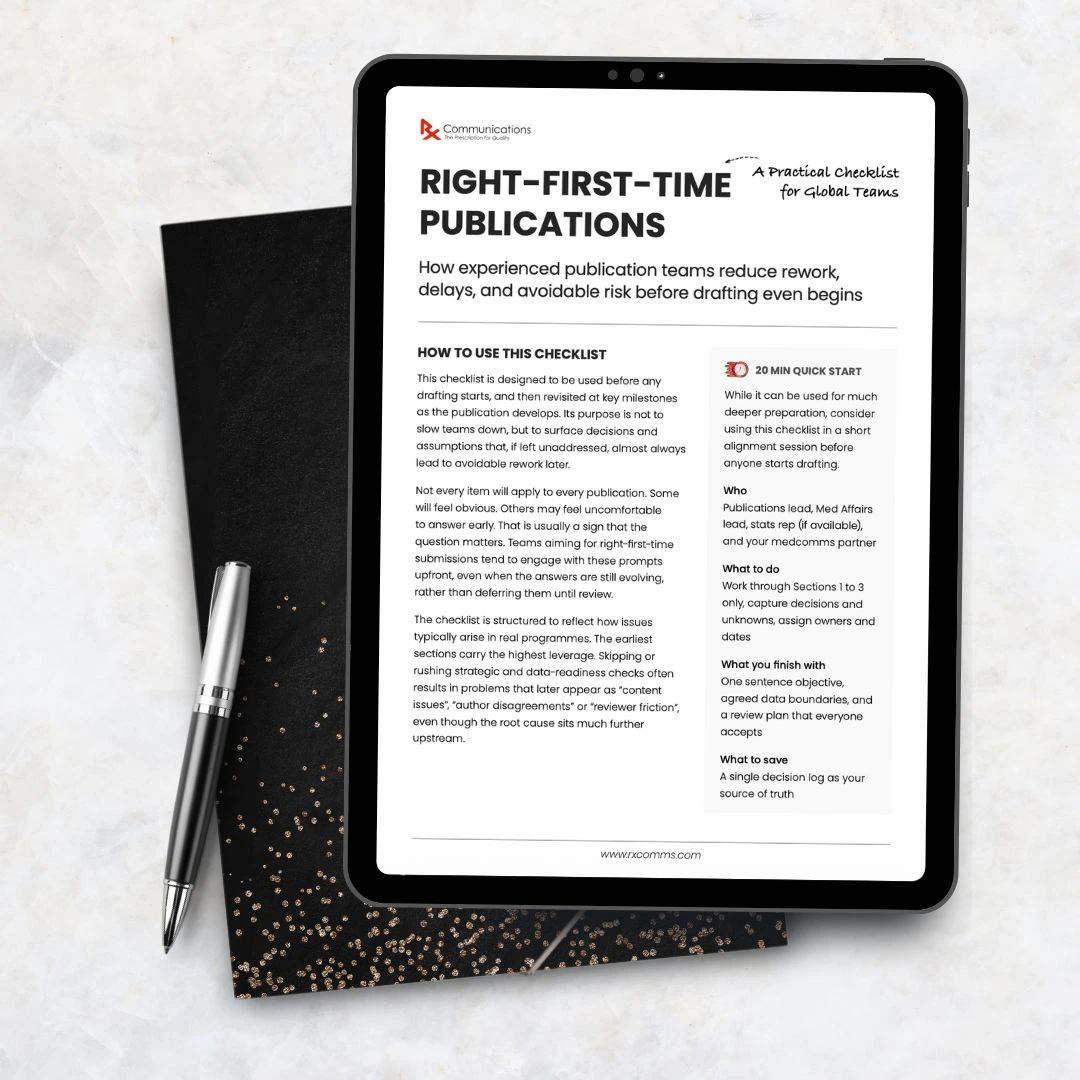
Download: Right-First-Time Publications – A Practical Checklist for Global Teams

This practical checklist is designed for global medical affairs, publications, and cross-functional teams responsible for transforming complex datasets into credible, high-quality outputs under real-world constraints.
Dear Gentle Reader,

We hope that your year has started as auspiciously as ours;  I have every hope that 2026 is going to be radically different from 2025 (but in a good way). If your 2025 was an epic year, then we wish you more or even better of the same.

One of the determinants of a good, bad or ugly year for a publications manager, is the quality, timeliness and successful publication of the data under their jurisdiction. Every seasoned publications manager and medcomms agency has a drawerful of horror stories when publications went unbearably wrong.

Those cringe-worthy examples that made us rethink our careers, bang our heads on the desk, and swear never to touch another draft. Happily, the majority of us pick ourselves up, dust off our jackets, and plunge in again, albeit sadder and wiser. The following sage advice is designed to remind you where some of the slip ups can occur – an angst-avoidance tool, as it were.  

Happy reading!

Ruth

The Story Starts Before Submission

Every publication enters the world carrying a story, whether that story has been carefully shaped or allowed to emerge by default. Press conferences, late-breaker submissions, and congress abstracts all signal narrative intent long before a manuscript is accepted, and often before teams realise a narrative has been set at all.

Problems arise when the story forms reactively. When timelines, submission windows, or external expectations drive decisions, messaging can become fragmented, inconsistent, or overly tactical. The result is a narrative that responds to pressure rather than purpose.

Experienced teams begin pulling the story together as data matures, not after acceptance. They consider what the data means, how it fits within the broader evidence landscape, and how it should be interpreted across different audiences and moments in time. This early thinking creates a foundation that supports coherence across congress activity, press engagement, and downstream publications.

The alternative is costly. Fragmented storytelling leads to mixed messages, duplicated effort, and unnecessary strain on credibility. Aligning early allows teams to move with intent, ensuring that each output contributes to a consistent, credible narrative rather than competing versions of the same story.

One Dataset, Many Audiences, Many Vehicles

A single dataset can legitimately support multiple outputs, but not all vehicles serve the same purpose. Original research papers, value dossiers, patient materials, and press briefings each answer different questions, for different audiences, at different points in the evidence lifecycle.

Challenges arise when format decisions are driven by habit rather than intent. Defaulting to a journal article simply because data exist can lead to misaligned messaging, underwhelming impact, or unnecessary publication risk. Strategic teams ask a different question early: what is this output for? rather than what can we publish?

Choosing the right vehicle requires understanding who needs the information, how they will use it, and when it matters most. A clinician assessing practice change, a payer evaluating value, and a patient seeking understanding will engage with the same data in very different ways. Matching format to audience, decision-making moment, and lifecycle stage allows the data to do its job more effectively.

Forcing every message into a journal-shaped container carries real risk. It can dilute key insights, create pressure to overinterpret results, or lead to missed opportunities elsewhere in the communication ecosystem. Thoughtful vehicle selection ensures each output plays a distinct role, supports the broader narrative, and strengthens the overall impact of the evidence.

Practical Guide – Building a Right-First-Time Publication Pathway

In a global context, right-first-time publication rarely means a perfect first draft. It means designing a pathway that reduces avoidable friction and supports timely decision-making, allowing high-quality work to move forward without repeated disruption.

At its core, a right-first-time approach depends on early planning, cross-functional alignment, and clearly defined roles. Teams that invest time upfront to agree objectives, audiences, data scope, and ownership tend to move more smoothly through development and review. Those decisions create guardrails that prevent late-stage surprises.

Most delays and diluted impact can be traced back to a small number of recurring failure points: narrative shifts introduced late in development, unclear decision ownership, and timelines that are misaligned across global, regional, and affiliate teams. These issues rarely appear dramatic at the start, but they compound quickly once drafting and review are underway.

The following checklist is designed as a practical tool to help teams sanity-check these fundamentals before submission. Used early and revisited at key moments, it supports more confident execution and helps teams identify risk while it is still manageable.

Deeper dives into metrics and impact factor

(for researchers, academics and publications managers)
Drats, looks like we're out of stock of that blog topic, click on the 'View All' button below and find some other tasty morsels for your consumption.

Spotlight on the blog 

This month’s blog content builds on the same right-first-time principles, with a sharper focus on the decisions that shape outcomes long before submission.

How to Spot a Publication That Will Need Reworking (Before it Does)

An experienced-team perspective on the early warning signs that signal trouble ahead. From unclear ownership and misaligned expectations to structural and strategic issues that surface too late, this article helps teams recognise and address problems while they are still easy to fix. [Read it here]

If this newsletter has stirred a few familiar memories, or prompted a small nod of recognition, you are not alone. Publication work is complex and high-pressure, and even the most experienced teams encounter moments where things wobble.  

Our hope is that the ideas shared here help you pause earlier, ask better questions, and shape clearer pathways from data to story. Small decisions made upstream can make an extraordinary difference downstream.

As ever, we welcome conversation. Whether you are refining an upcoming programme or untangling one already in motion, we are always happy to talk.

Best wishes for a calmer, clearer publication year ahead.

[Contact us]

February Newsletter 2026: From Data to Story

Things you should know about Journals...

To support you in this, we've prepared a number of articles to assist you in making the right journal selection for your publication. If you would like a broad overview, start with our comprehensive article 'Navigating the Journal Selection & Submission Process', or jump in to one of these other related topics and get the information you need to be successful!
No items found.

February Newsletter 2026: From Data to Story

Right-First-Time Publications Checklist

This practical checklist is designed for global medical affairs, publications, and cross-functional teams responsible for transforming complex datasets into credible, high-quality outputs under real-world constraints.

No items found.

Share this post

We'll deliver straight to your inbox

You're subscribed! We'll send you a welcome email shortly, keep an eye out and if you don't find it perhaps check the (sometimes over-zealous) spam folder.
Oops! Something went wrong while submitting the form.

We'll deliver straight to your inbox

You're subscribed! We'll send you a welcome email shortly, keep an eye out and if you don't find it perhaps check the (sometimes over-zealous) spam folder.
Oops! Something went wrong while submitting the form.

Did you enjoy that?

Why not check out these other related articles while you're here.