

Dear Gentle Reader
One of my closest relatives is applying to participate in a clinical trial here in New Zealand. They are desperate to be accepted, and truthfully, I’m desperate for them to be accepted too. Receiving a description in only layman’s terms, I have difficulty in judging whether this is a real randomised controlled clinical trial or whether it is closer to a pragmatic trial or even an observational one. I hear it might have a placebo arm and that applicants undergo a large number of interviews and tests before acceptance, but that’s all I know. I haven’t wanted to invade their privacy by asking more or even researching it.
In any case, both the applicant and family are really wanting to be accepted. The trial had to close recruitment early, suggesting they are far from alone. Trials like this suggest that where treatment is expensive or difficult to access, patient desperation can overcome fears about untested treatments. However, I don’t think this level of interest in a trial is universal; some trials struggle to recruit enough participants.
But how often do we ask patients what would make a trial worth joining in the first place? Patient involvement in trial design is growing, yet the outcomes researchers and pharmaceutical companies value are not always those patients value most. Perhaps some recruitment problems begin long before recruitment itself.
Happy reading,
Ruth
Randomised clinical trials (RCTs) are, rightly so, the gold-standard for getting a new medication across the line. But every type of medical evidence answers a different question. RCTs tell us whether a treatment can work under carefully controlled conditions, which is, of course, necessary, but does not tell us the full story. For a treatment to be successful in everyday practice, researchers, clinicians, regulators, patients, and, well, everyone, need to know more. We need to know how this treatment performs in the real world.
Clinical trials are the foundation, not the full picture

As we know, RTCs are designed to minimise variables so efficacy and safety can be measured reliably. This is done by randomisation and blinding to reduce bias, strict inclusion and exclusion criteria, a closer monitoring of patients than in routine practice.
While this makes RTCs scientifically robust, it does not usually reflect everyday healthcare. For example, patients in oncology trials often receive intensive monitoring and follow up that would be difficult to replicate in routine care. Additionally, early-phase clinical trials in oncology often enrol patients in the last stages of disease, even if the medication is eventually intended for first- or second-line therapy.
Pragmatic clinical trials (PCTs) can provide a different perspective. PCTs are interventional trials and are sometimes randomised, but they evaluate treatments under conditions closer to routine clinical practice. Eligibility criteria may therefore be broader, allowing some patients who would have been excluded from a RCT to participate. The PRECIS-2 framework helps researchers assess where a trial sits on the continuum between highly RCT and PCT design.
Real-world evidence (RWE) is a step further into routine practice. Rather than being generated within a conventional randomised trial, the data can come from sources such as electronic health records, registries, claims data and routine clinical care. RWE can provide additional information about how treatments are used and perform in broader patient populations.
When medicines reach the real world
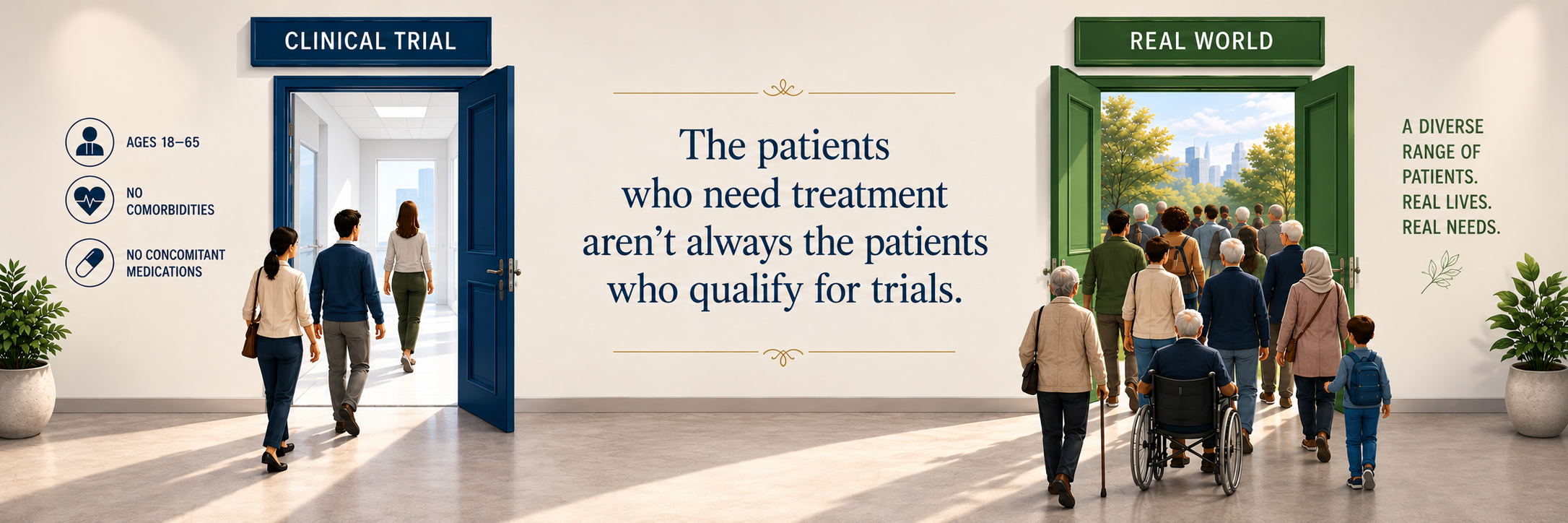
Many of the patients clinicians treat every day would never have qualified for the pivotal clinical trial. Whether due to age, sex, comorbidities or concurrent medications, strict exclusion criteria mean clinical trials do not necessarily represent the intended population.
How is this gap filled? Real-world evidence.
Recruitment can often be a challenge in clinical trials, meaning many patient groups may be underrepresented, whether intended or not by the trial coordinators. Additionally, adherence and outcomes can vary when a medication is used in the real world, likely in part due to the reduced monitoring patients receive outside of the clinical trial environment.
.png)
Did you know?
One RWE study* found that 55.1% of patients who take empagliflozin, a medication used to treat type 2 diabetes, heart failure, and chronic kidney disease, would have been ineligible for phase 3 clinical trials.1
*This 2020 study compared 7,034 patients who began taking empagliflozin for the first time between 2014–2018. Of these patients, 55.1% would have been ineligible for the clinical trials, most commonly due to baseline HbA1c levels, concomitant medications, or comorbidities. However, reductions in HbA1c in this population were similar to that observed in clinical trials.1
Measuring what matters to patients
Traditionally, many clinical trials have prioritised survival endpoints such as overall survival, progression-free survival, and duration of response, with measures such as quality of life (QoL) being secondary. However, patient priorities do not necessarily reflect this order. In a systematic review of 28 studies, patients most frequently ranked QoL as their top priority, followed by survival endpoints and severe adverse events.2
So while survival endpoints are obviously essential, perhaps QoL measures should be treated more equally. Instead of only asking questions like “does the tumour shrink?” more emphasis should be placed on questions such as whether the patients can return to work, whether they can sleep well, climb stairs, or keep up with their families.
However, this is not to say that collecting this information is easy. Patient-reported outcomes are not always directly comparable across countries; cultural expectations, communication styles, and healthcare systems influence how symptoms are described. Historically, a more paternalistic doctor-patient relationship occurred in Japan than in many Western countries. Doctors decided how much information to disclose, often acting as gate-keepers of information, particularly in relation to serious diagnoses. This illustrates how differences in medical culture and communication can shape not only patients' experiences of illness, but also how they interpret and report their symptoms, making comparisons of patient-reported outcomes across settings more challenging.
Developing globally meaningful outcome measures is more complex than simply translating a questionnaire – which is actually not simple, and rather problematic as colloquialisms differ, particularly when describing pain or other symptoms relating to QoL, making a word-for-word translation difficult for patients to interpret correctly.
The role of regulatory writing

While clinical trials remain the gold-standard for regulatory decision-making, health outcomes research, patient-reported outcomes and real-world evidence add important context. The content of regulatory submissions should draw on these evidence sources, too. Each evidence type has a different methodology, purpose, and set of limitations, and requires different types of outputs. This is where the role of the regulatory writer comes in.
Regulatory writing encompasses a wide range of documents including clinical study reports, investigator's brochures, clinical overviews, summaries of clinical efficacy and safety, briefing documents, responses to regulatory questions, and risk management plans. Different regulatory documents have distinct purposes and audiences, varying in the levels of technical detail, interpretation, and emphasis.
Evidence from different study types must be interpreted within the context of their design, patient population and endpoints. Regulatory writers must communicate what each dataset demonstrates, while being clear about what conclusions cannot be drawn.
The role of the regulatory writer has evolved alongside drug development, requiring an understanding of diverse evidence types and how they fit together. Although most drug registration submissions follow the standardised Common Technical Document (CTD) structure, regulatory requirements differ across agencies such as the Food and Drug Administration (FDA), European Medicines Agency (EMA), Pharmaceuticals and Medical Devices Agency (PMDA) in Japan, or Medsafe in New Zealand. Country- and region-specific requirements may include different formatting, local regulatory expectations, requests for subgroup analyses, or additional evidence such as local clinical data or real-world evidence.
All evidence types are important for the approval and success of a medication. Tying them all together for regulatory submission requires an understanding of the regulatory frameworks, guidance documents, and review expectations of each jurisdiction.
We'll deliver straight to your inbox
Notable news
Cybersecurity breach in patient information
Baylor Genetics has reported a cybersecurity breach in which an unauthorised third party accessed parts of its network over several days in June. Compromised patient information varied by individual but included medical testing information and laboratory results, while some personal and employee data were also affected. The incident comes amid a growing number of cyberattacks across medtech and biopharma. Read more here
New PET imagining for Alzheimer’s Disease
The FDA has cleared Lantheus’ Tauklarify, a PET imaging agent designed to identify tau neurofibrillary tangle pathology in patients with cognitive impairment being evaluated for Alzheimer’s disease. Supported by two clinical trials involving more than 500 participants, tau PET imaging provides information that complements amyloid PET and other diagnostic tools. The safety and effectiveness has not been established in non-Alzheimer's disease tauopathies. Read more here
Positive results for LSD-based therapy for anxiety
Definium Therapeutics has reported positive phase 3 results for DT120, its LSD-based therapy for generalized anxiety disorder. In the 214-patient Voyage trial, a single dose of the orally disintegrating tablet reduced anxiety symptoms by 11.6 points at week 12, compared with 6.2 points for placebo. The results follow positive phase 3 data in major depression, with a further anxiety study (Panorama) expected to read out next month. Read more here
References
- Munk NE, Knudsen JS, Pottegård A, Witte DR, Thomsen RW. Differences Between Randomized Clinical Trial Participants and Real-World Empagliflozin Users and the Changes in Their Glycated Hemoglobin Levels. JAMA Netw Open. 2020;3(2):e1920949.
- Seghers PALN, Wiersma A, Festen S, et al. Patient Preferences for Treatment Outcomes in Oncology with a Focus on the Older Patient-A Systematic Review. Cancers (Basel). 2022;14(5):1147.
.webp)