

July Newsletter 2026: Signals From Competitor Congress Outputs

Approx.
6 mins read

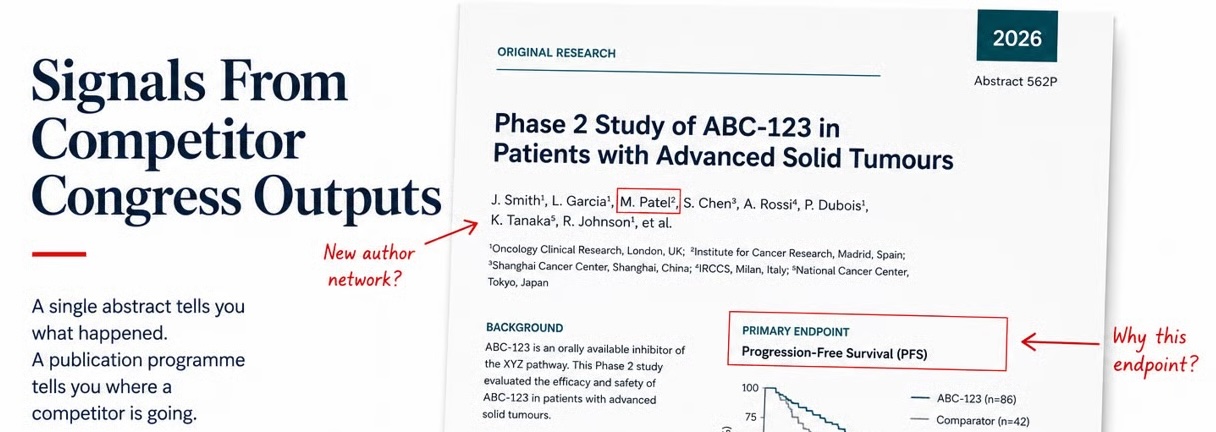
In this month's newsletter, we look beyond the results to uncover the patterns that can shape more informed medical communications strategies, because a single abstract tells you what happened, but a publication programme tells you where a competitor is going.

First Published: 
Jul 2026
Updated: 
First Published: 
Jul 2026
|
Updated: 

Other pages on the topic:

No items found.

Key learnings contained in this article:

Dear Gentle Reader,

Competitors. What a wonderful species. You should know, because how often do pharma personnel jump ship to a competitor when their promotion is considered late, or their payrise doesn’t reflect their work. Not direct competitor companies perhaps, but the jumpee will soon be able to understand the new company culture, and ascertain many of the strategies. If you don’t have the advantage of a mobile career, Beth's comments below may give you just the insights you need to make a brilliant success of your congresses. And of course, earn that payrise or promotion.

Happy reading,

Ruth

Stop reading competitor abstracts as isolated publications
When a competitor presents new data at a major congress, it is natural to focus on the results. The efficacy, the safety profile, and the subgroup analyses are, after all, the headline findings. But if that is all you are looking at, you may be missing the more interesting story.

Experienced publications teams know that an abstract is just one piece of a much broader publication programme, and every decision surrounding it is deliberate. What is chosen for publication, where it is presented, when it appears, and how it is positioned can reveal just as much as the data alone.

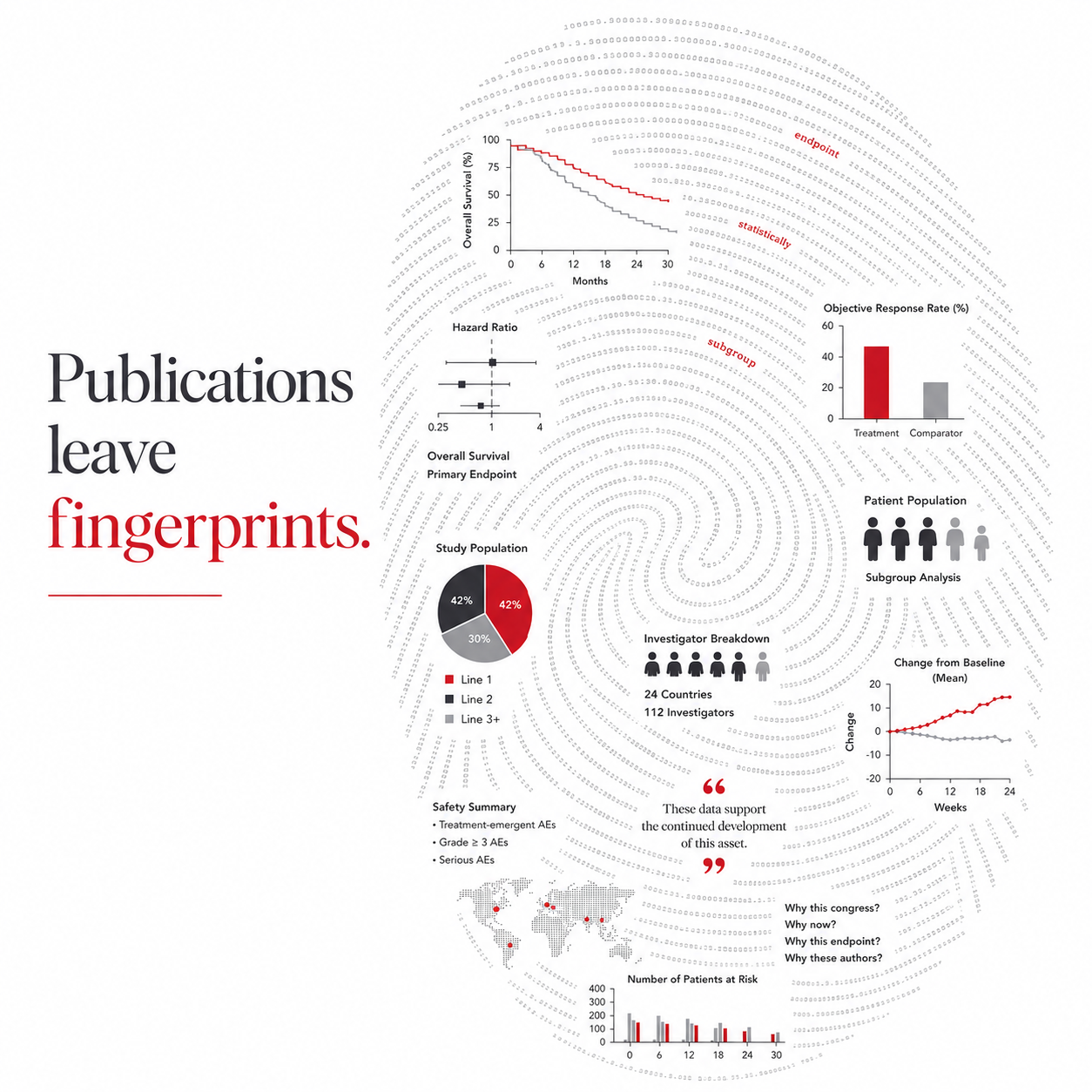
Viewed over time, competitor outputs begin to leave strategic fingerprints. They can reveal how much confidence a company has in a dataset, which audiences it is prioritising, where it believes differentiation lies, and how its scientific narrative is evolving as an asset progresses towards launch. Sometimes, these fingerprints also reveal what a company is choosing not to emphasise.

The most valuable insights rarely come from a single publication. They emerge through patterns. Has a particular endpoint become more prominent across successive congresses? Has the language shifted from exploratory to more confident claims? Are earlier-phase studies receiving greater visibility than before? Is the company investing in smaller regional congresses to reach specific audiences? Have certain patient populations steadily moved from secondary analyses to the centre of the narrative? Perhaps most revealing of all, which studies or datasets never make the journey from congress abstract to peer-reviewed manuscript?

Look for what isn't being said

A large part of competitor intelligence is also about noticing what has disappeared.

Scientific narratives evolve over time, and those changes are not random. Companies make deliberate decisions about which findings to develop, which messages to reinforce, and which areas to leave behind. Looking for these omissions can provide valuable clues about changing priorities.

Has an endpoint that featured prominently last year disappeared? Have exploratory analyses failed to progress into later publications? Has a familiar investigator or author group been replaced by a new network of experts? Are certain congresses no longer receiving the same level of attention? Why did one study warrant a press release while another was presented only as a poster?

None of these observations provides a definitive answer in isolation. A study may not become a manuscript for any number of reasons, and a shift in authorship does not necessarily signal a change in strategy. However, when several of these signals appear together over time, they begin to paint a clearer picture.

The strongest competitor intelligence comes from recognising patterns, rather than isolated events.

Practical guide: Five competitor signals worth tracking at every congress

Monitoring competitor outputs is not about collecting more abstracts or posters. It is about knowing which patterns are worth paying attention to. The signals below can provide useful context when viewed over multiple congresses and publication cycles.

1. Repeated messaging across multiple outputs
If the same themes, endpoints, or value messages appear consistently across abstracts, posters, presentations, and manuscripts, it is unlikely to be accidental. Repetition often reflects the aspects of the data a company believes will differentiate its asset and form the foundation of its scientific narrative.

2. New endpoints receiving prominence
Pay attention to which endpoints are moving from secondary analyses into headlines or conclusions. This may indicate a shift in how a company intends to position its product, particularly if those endpoints address an unmet need or offer a point of distinction from competitors.

3. Increase in publication volume
A noticeable rise in congress activity, publications, or educational outputs can signal increasing investment in an asset. This often occurs as programmes move towards major regulatory, clinical, or commercial milestones, when building scientific awareness becomes increasingly important.

4. Shift in author network
Changes in authorship can reveal more than new collaborators. A broader or different group of investigators may indicate expansion into new regions, stronger engagement with key opinion leaders, or efforts to build advocacy within specific clinical communities.

5. Consistent language changes
Small changes in wording can be surprisingly revealing. Watch for shifts in how a disease burden is described, how benefits are framed, or which terms are consistently emphasised across successive outputs. Over time, these changes often signal the evolution of a company's scientific narrative as it prepares for the next stage of development.

Practical guide: Should you attend in person or virtually?

The answer depends on what you want to achieve.

If your primary objective is to access the scientific data, virtual attendance has become an increasingly viable option. Presentations and posters are often available on demand, travel costs are eliminated, and larger teams can divide sessions between them. For organisations working within budget constraints, it offers an efficient way to stay informed.

However, if your goal extends beyond the published data, attending in person still offers advantages that are difficult to replicate online.

Some of the most valuable insights come from the conversations taking place around the presentations rather than on the slides themselves. Which posters are attracting the largest crowds? Which findings are generating debate? What questions are investigators repeatedly asking? How are competitors choosing to present and defend their data? These observations can add valuable context to the published results.

There is also the opportunity to build relationships with investigators, key opinion leaders, and peers across the industry, while gaining a broader sense of competitor presence and activity throughout the meeting.

Ultimately, neither approach is inherently better. Virtual attendance offers efficiency and accessibility, while attending in person provides context that is often difficult to capture remotely.

If your role involves competitor intelligence, remember that publications are only part of the story. Sometimes, understanding how people respond to a presentation can be just as informative as the presentation itself.

We'll deliver straight to your inbox

You're subscribed! We'll send you a welcome email shortly, keep an eye out and if you don't find it perhaps check the (sometimes over-zealous) spam folder.
Oops! Something went wrong while submitting the form.

Notable news

NICE backs two non-invasive tests to speed up endometriosis diagnosis

The UK's National Institute for Health and Care Excellence (NICE) has recommended the early NHS use of two non-invasive diagnostic tests for endometriosis, EndoSure and Endotest. The technologies, which use abdominal sensors and a saliva sample respectively, aim to reduce the average diagnostic delay of 10 years, while additional evidence is gathered over a three-year evaluation period. If successful, they could improve earlier access to diagnosis and treatment for thousands of endometriosis patients. Read more

China approves the world's first CAR-T therapy for a solid tumours

China has become the first country to approve a CAR-T therapy for a solid tumour, marking a significant milestone for a treatment approach that has so far been largely confined to blood cancers. The approval of CARsgen's therapy for advanced gastric cancer highlights the growing momentum behind CAR-T therapies for solid tumours, an area that has long presented significant scientific challenges. Read more

FDA approves first dual BAFF/APRIL-targeting therapy for IgA nephropathy

The FDA has approved Trutakna (atacicept-vymj) for adults with primary immunoglobulin A (IgA) nephropathy who are at risk of disease progression. In clinical trials, the treatment achieved a 46% reduction in proteinuria after nine months, compared with 7% for placebo, marking an important advance for patients with this progressive kidney disease. As the first approved therapy to target both B cell activating factor (BAFF) and A Proliferation Inducing Ligand APRIL, Trutakna introduces a new mechanism of action to the IgA nephropathy treatment landscape. Read more

We'll deliver straight to your inbox

You're subscribed! We'll send you a welcome email shortly, keep an eye out and if you don't find it perhaps check the (sometimes over-zealous) spam folder.
Oops! Something went wrong while submitting the form.

Dear Gentle Reader,

Competitors. What a wonderful species. You should know, because how often do pharma personnel jump ship to a competitor when their promotion is considered late, or their payrise doesn’t reflect their work. Not direct competitor companies perhaps, but the jumpee will soon be able to understand the new company culture, and ascertain many of the strategies. If you don’t have the advantage of a mobile career, Beth's comments below may give you just the insights you need to make a brilliant success of your congresses. And of course, earn that payrise or promotion.

Happy reading,

Ruth

Stop reading competitor abstracts as isolated publications

When a competitor presents new data at a major congress, it is natural to focus on the results. The efficacy, the safety profile, and the subgroup analyses are, after all, the headline findings. But if that is all you are looking at, you may be missing the more interesting story.

Experienced publications teams know that an abstract is just one piece of a much broader publication programme, and every decision surrounding it is deliberate. What is chosen for publication, where it is presented, when it appears, and how it is positioned can reveal just as much as the data alone.

Viewed over time, competitor outputs begin to leave strategic fingerprints. They can reveal how much confidence a company has in a dataset, which audiences it is prioritising, where it believes differentiation lies, and how its scientific narrative is evolving as an asset progresses towards launch. Sometimes, these fingerprints also reveal what a company is choosing not to emphasise.

The most valuable insights rarely come from a single publication. They emerge through patterns. Has a particular endpoint become more prominent across successive congresses? Has the language shifted from exploratory to more confident claims? Are earlier-phase studies receiving greater visibility than before? Is the company investing in smaller regional congresses to reach specific audiences? Have certain patient populations steadily moved from secondary analyses to the centre of the narrative? Perhaps most revealing of all, which studies or datasets never make the journey from congress abstract to peer-reviewed manuscript?

Look for what isn't being said

A large part of competitor intelligence is also about noticing what has disappeared.

Scientific narratives evolve over time, and those changes are not random. Companies make deliberate decisions about which findings to develop, which messages to reinforce, and which areas to leave behind. Looking for these omissions can provide valuable clues about changing priorities.

Has an endpoint that featured prominently last year disappeared? Have exploratory analyses failed to progress into later publications? Has a familiar investigator or author group been replaced by a new network of experts? Are certain congresses no longer receiving the same level of attention? Why did one study warrant a press release while another was presented only as a poster?

None of these observations provides a definitive answer in isolation. A study may not become a manuscript for any number of reasons, and a shift in authorship does not necessarily signal a change in strategy. However, when several of these signals appear together over time, they begin to paint a clearer picture.

The strongest competitor intelligence comes from recognising patterns, rather than isolated events.

Practical guide: Five competitor signals worth tracking at every congress

Monitoring competitor outputs is not about collecting more abstracts or posters. It is about knowing which patterns are worth paying attention to. The signals below can provide useful context when viewed over multiple congresses and publication cycles.

1. Repeated messaging across multiple outputs
If the same themes, endpoints, or value messages appear consistently across abstracts, posters, presentations, and manuscripts, it is unlikely to be accidental. Repetition often reflects the aspects of the data a company believes will differentiate its asset and form the foundation of its scientific narrative.

2. New endpoints receiving prominence
Pay attention to which endpoints are moving from secondary analyses into headlines or conclusions. This may indicate a shift in how a company intends to position its product, particularly if those endpoints address an unmet need or offer a point of distinction from competitors.

3. Increase in publication volume
A noticeable rise in congress activity, publications, or educational outputs can signal increasing investment in an asset. This often occurs as programmes move towards major regulatory, clinical, or commercial milestones, when building scientific awareness becomes increasingly important.

4. Shift in author network
Changes in authorship can reveal more than new collaborators. A broader or different group of investigators may indicate expansion into new regions, stronger engagement with key opinion leaders, or efforts to build advocacy within specific clinical communities.

5. Consistent language changes
Small changes in wording can be surprisingly revealing. Watch for shifts in how a disease burden is described, how benefits are framed, or which terms are consistently emphasised across successive outputs. Over time, these changes often signal the evolution of a company's scientific narrative as it prepares for the next stage of development.

Practical guide: Should you attend in person or virtually?

The answer depends on what you want to achieve.

If your primary objective is to access the scientific data, virtual attendance has become an increasingly viable option. Presentations and posters are often available on demand, travel costs are eliminated, and larger teams can divide sessions between them. For organisations working within budget constraints, it offers an efficient way to stay informed.

However, if your goal extends beyond the published data, attending in person still offers advantages that are difficult to replicate online.

Some of the most valuable insights come from the conversations taking place around the presentations rather than on the slides themselves. Which posters are attracting the largest crowds? Which findings are generating debate? What questions are investigators repeatedly asking? How are competitors choosing to present and defend their data? These observations can add valuable context to the published results.

There is also the opportunity to build relationships with investigators, key opinion leaders, and peers across the industry, while gaining a broader sense of competitor presence and activity throughout the meeting.

Ultimately, neither approach is inherently better. Virtual attendance offers efficiency and accessibility, while attending in person provides context that is often difficult to capture remotely.

If your role involves competitor intelligence, remember that publications are only part of the story. Sometimes, understanding how people respond to a presentation can be just as informative as the presentation itself.

Deeper dives into metrics and impact factor

(for researchers, academics and publications managers)
Drats, looks like we're out of stock of that blog topic, click on the 'View All' button below and find some other tasty morsels for your consumption.

Notable news

NICE backs two non-invasive tests to speed up endometriosis diagnosis

The UK's National Institute for Health and Care Excellence (NICE) has recommended the early NHS use of two non-invasive diagnostic tests for endometriosis, EndoSure and Endotest. The technologies, which use abdominal sensors and a saliva sample respectively, aim to reduce the average diagnostic delay of 10 years, while additional evidence is gathered over a three-year evaluation period. If successful, they could improve earlier access to diagnosis and treatment for thousands of endometriosis patients. Read more

China approves the world's first CAR-T therapy for a solid tumours

China has become the first country to approve a CAR-T therapy for a solid tumour, marking a significant milestone for a treatment approach that has so far been largely confined to blood cancers. The approval of CARsgen's therapy for advanced gastric cancer highlights the growing momentum behind CAR-T therapies for solid tumours, an area that has long presented significant scientific challenges. Read more

FDA approves first dual BAFF/APRIL-targeting therapy for IgA nephropathy

The FDA has approved Trutakna (atacicept-vymj) for adults with primary immunoglobulin A (IgA) nephropathy who are at risk of disease progression. In clinical trials, the treatment achieved a 46% reduction in proteinuria after nine months, compared with 7% for placebo, marking an important advance for patients with this progressive kidney disease. As the first approved therapy to target both B cell activating factor (BAFF) and A Proliferation Inducing Ligand APRIL, Trutakna introduces a new mechanism of action to the IgA nephropathy treatment landscape. Read more

July Newsletter 2026: Signals From Competitor Congress Outputs

Things you should know about Journals...

To support you in this, we've prepared a number of articles to assist you in making the right journal selection for your publication. If you would like a broad overview, start with our comprehensive article 'Navigating the Journal Selection & Submission Process', or jump in to one of these other related topics and get the information you need to be successful!
No items found.

July Newsletter 2026: Signals From Competitor Congress Outputs

We'll deliver straight to your inbox

You're subscribed! We'll send you a welcome email shortly, keep an eye out and if you don't find it perhaps check the (sometimes over-zealous) spam folder.
Oops! Something went wrong while submitting the form.
No items found.
Beth is a freelance medical writer from New Zealand with a Bachelor of Biomedical Science and a passion for studying neurodegenerative diseases and women’s health. With a knack for turning dense medical research into engaging, accessible content, Beth is on a mission to improve health literacy for patients and the public alike.

Share this post

We'll deliver straight to your inbox

You're subscribed! We'll send you a welcome email shortly, keep an eye out and if you don't find it perhaps check the (sometimes over-zealous) spam folder.
Oops! Something went wrong while submitting the form.

We'll deliver straight to your inbox

You're subscribed! We'll send you a welcome email shortly, keep an eye out and if you don't find it perhaps check the (sometimes over-zealous) spam folder.
Oops! Something went wrong while submitting the form.

Did you enjoy that?

Why not check out these other related articles while you're here.