


Dear Gentle Reader,
I’ve been a poster judge at conferences, as I believe many of you will have been too. As judges, we usually only review the top 3 posters within a topic, and because they are the top three, finding a winner rarely comes down to formatting differences or clear messages, but more on the actual data and its contribution to the therapeutic area.
However, sometimes the contrasts across the poster presentations are extreme. Some won’t have followed the congress guidelines on size, and will either be pathetically small, or encroaching on the neighbouring presentations. Some will have so much information squeezed on the poster that one has to stand no more than 6 inches away to absorb the content, which may need reading twice or more before it's understandable. Others may have so little information amongst the fluff that one wonders how it passed the reviewing committee.
Abstract and subsequent poster quality overall has increased considerably over the years, but is there still room for improvement? Let's see what Beth thinks…
Yours as ever,
Ruth

Behind every congress lies years of work, substantial investment, and often a great deal of anticipation. By the time a study reaches the abstract planning stage, it is only natural to want the data to work as hard as possible. After all, you have spent years generating evidence, why not showcase every interesting finding?
Along comes the familiar temptation; one abstract becomes responsible for the primary endpoint, several secondary analyses, subgroup analyses, exploratory findings, clinical context, and perhaps a glimpse of future research for good measure. More messages are added in the hope of increasing impact, although the outcome tends to be the opposite.
When an abstract tries to tell too many stories at once, the central message can become difficult to find.
Reviewers are left searching for the key finding, and readers may finish the abstract unsure what they were meant to take away from it.
The same challenge frequently appears on posters. Faced with an expanse of blank space, teams understandably feel compelled to fill it. Additional analyses find their way onto the page, figures multiply, and before long, several competing narratives are vying for attention.
The difficulty is that congress audiences rarely engage with posters and abstracts in the careful, methodological way we imagine. Most are scanning quickly between sessions, pausing briefly before moving on to the next presentation. If the main message is not immediately apparent, there is a good chance it will be entirely overlooked.
More data do not necessarily create a stronger communication. More often the most memorable abstracts and posters are those with the discipline to focus on a single, clear story and tell it well.
Why Overreach Happens

Most teams are trying to solve a genuine problem: how to make the most of a valuable dataset. Sometimes the primary endpoint delivers exactly what was expected, but the findings generating the most excitement sit elsewhere. A secondary endpoint, a tolerability outcome, or a post hoc analysis may feel far more relevant to clinicians than the headline result.
When primary endpoint data show equivalence or only modest differences, the pressure can increase. Concerns about acceptance, visibility, and audience interest can tempt teams to include every potentially compelling finding in a single submission.
Congress rules can add another layer of complexity. Some meetings permit only one abstract per trial, a restriction that is not always discovered until planning is already underway. By that stage, difficult decisions about what to include and what to leave out can feel uncomfortably late.
The Acceptance Barrier
What if your primary end point is not the most interesting result?
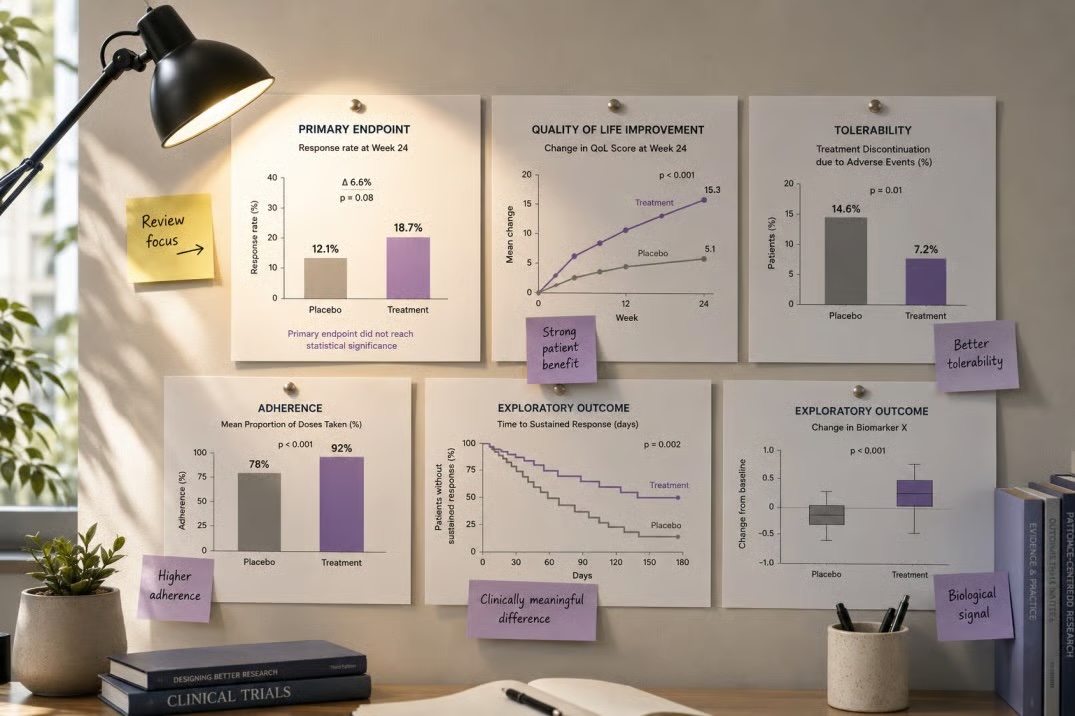
A common dilemma arises when the primary endpoint is not the result people are talking about. Many studies generate genuinely interesting findings beyond the primary analysis. Quality of life improvements, tolerability benefits, adherence data, and exploratory outcomes can all resonate strongly with clinical audiences. Yet abstract review committees often remain focused on the primary endpoint when assessing scientific merit.
This creates an awkward tension between scientific hierarchy and practical relevance. The instinctive response is often to include every potentially interesting finding in the hope that something will capture attention. Unfortunately, this can have the opposite effect, diluting the strongest message and leaving reviewers unsure where to focus.
Rather than trying to rescue a modest headline result with an ever-growing list of secondary analyses, it is usually more effective to frame supporting findings carefully, anchor them to the study objective, and maintain a clear narrative throughout. The less dramatic the headline result, the more valuable that discipline becomes.
Understanding the Congress Audience
Not all congresses are looking for the same thing. A strategy that works beautifully at one meeting may fall flat at another. Some congresses favour hard clinical outcomes, while others are more receptive to real-world evidence, patient-reported outcomes, or exploratory analyses. Looking back at previously accepted abstracts can often reveal useful patterns, not only in the data selected but also in how the story is told.
It is also worth remembering that abstracts are reviewed by people, not algorithms. Review committee membership can change from year to year, and individual reviewers or leadership groups may hold strong views within a therapeutic area. While no one can predict exactly how a submission will be received, understanding the audience behind the review process can help teams make more informed decisions about which data to emphasise and how best to position their findings.
Posters That Do Too Much
Abstracts are not the only victims of over-enthusiasm. Posters often become the final resting place for every analysis that did not make it into the submission.
The result can be a crowded collection of figures, tables, and text boxes all competing for attention. Yet most congress attendees spend seconds, not minutes, deciding whether a poster is worth reading.
If the main message is not immediately obvious, readers will simply move on. More content may fill the space, but it rarely increases the scientific value of the communication.
Three Pressure-Test Questions Before Submission
- What is the single message this abstract or poster needs to land?
- Which data genuinely support that message, and which distract from it?
- If a congress attendee remembered only one figure or conclusion, what should it be?
We'll deliver straight to your inbox
Spotlight on the Blog
Our latest blog explores six questions worth asking before drafting starts, helping teams avoid overcrowded submissions, align stakeholders, and focus on the message that matters most.
Read the article here 6 Questions to Ask Before You Draft an Abstract
.webp)